
Among Rocks & Rapids: Story of the Ghats
How the Eastern and Western Ghats Are Different and Similar to Each Other
By Karthickeyen K.S.
Estimated read time: 3–4 minutes
India narrows into a triangle as it runs south into the Indian Ocean, and along its two edges run two mountain ranges: the Western Ghats facing the Arabian Sea, and the Eastern Ghats facing the Bay of Bengal. Both sit on the same ancient basement rock, a leftover of the supercontinent Gondwana. But that shared origin is where the resemblance mostly ends. What follows is a story of two ranges that look like siblings on a map but turn out to be almost nothing alike underwater — separated not just by geography, but by an age gap measured in billions of years.

A Staggering Age Gap
The single biggest difference between the two ranges is age, and it explains a great deal of what follows. The Eastern Ghats began forming around 3 billion years ago — a point in Earth's history when the most complex life around was still single-celled. Billions of years of rain, wind, and river erosion have worked on the range ever since, carving it into disconnected clusters of hills rather than one continuous chain. The Western Ghats, by contrast, are almost startlingly young — formed somewhere between 65 and 150 million years ago, when dinosaurs still walked the earth. Their origin was violent: one of the largest volcanic events in Earth's history forced the western edge of the Indian plate to bulge upward and tilt the whole landmass eastward. There is only one real break in the entire range, a gap in Kerala left behind from an even older continental split — a crack the volcanic uplift simply couldn't close.

Where Monsoons Divide, and Rivers Reconnect
Age isn't the only thing that separates the two ranges — so does rainfall. From June onward, the southwest monsoon slams directly into the Western Ghats first, and some areas there take on more than 6,000 mm of rain in a single season. By the time whatever is left of that monsoon crosses the peninsula and reaches the Eastern Ghats, most of its moisture is already spent. The Eastern Ghats have to wait for a second delivery — the northeast monsoon arriving off the Bay of Bengal in October — and even then receive only a fraction of the rainfall, somewhere between 1,000 and 2,000 mm a year. Yet for all that separates them, something does physically connect the two ranges: rivers. The Kaveri, the Godavari, and the Krishna all originate in the Western Ghats, travel east across the entire peninsula, and pass straight through the Eastern Ghats before finally emptying into the Bay of Bengal. They are, quite literally, the link between two mountain ranges that otherwise share almost nothing about their present-day climate

The Same Fish, in Two Different Mountains
That river connection raises a genuinely open question. Some fish species turn up in hillstreams of both the Western and the Eastern Ghats — species that, on paper, shouldn't have any easy way of crossing between two ranges separated by the width of an entire peninsula. There are two competing explanations on the table. One is that these fishes belong to old lineages that had already spread across the peninsula before the Western Ghats had even fully formed, leaving descendants stranded in both ranges as the landscape changed around them. The other is that the river systems flowing between the two ranges acted as natural corridors, letting more adaptable, generalist species disperse over time. Which explanation holds — or whether it's some combination of both — is, as the story puts it, still being worked out. It's a mystery hiding in plain sight, in streams that have been surveyed for decades.
The T-Shirt Test
There's a simple way Kharthickeyen illustrates just how differently endemism plays out across the two ranges — through a t-shirt design featuring five Western Ghats fish species, each restricted to its own small stretch of river, arranged from largest to smallest.
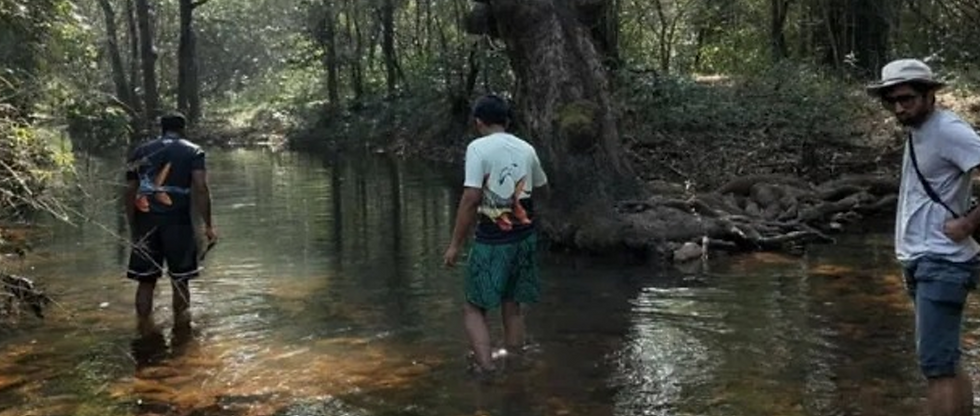
What makes the comparison striking is this: you could visit a single stream almost anywhere in the Eastern Ghats and have a reasonable chance of finding all five of those fish species swimming together in the same water. In the Western Ghats, it's the opposite story — each of those five fish is locked into its own specific corner of the range. To see all five in the wild, you'd need to travel the entire length of the Western Ghats, crossing several states and river systems along the way.
Same peninsula, same monsoon system, same ancestral rock — and yet two completely different ways of being a fish endemic to a mountain range. That single contrast — one range where rare fish cluster together, another where they're scattered across a thousand kilometres — is really the whole story of the Ghats in miniature.
Read the full story
The complete feature — including how the rivers physically link both ranges, the species found only on one side, and the fuller picture of how fish moved across a peninsula shaped by two different geological clocks — appears in the May 2026 issue of The Weekend Aquarist.
👉Buy this issue or subscribe to The Weekend Aquarist to experience the complete tribute.


Comments