
From The Wild: New Fish Discoveries
New fish species are discovered frequently in the wild, often in habitats under increasing threats. In Into the Wild: New Fish Discoveries, Balaji Vijayakrishnan takes us into the field, sharing firsthand accounts of newly described species, their habitats, and why these discoveries matter for conservation, and the aquarium community alike.
By V. Balaji
Estimated read time: 8–9 minutes

A Slippery Comeback: Rediscovery of Moringua hodgarti from Arunachal Pradesh
Authors: Nilanjan Mukherjee, Rahul G. Kumar, Surya Narayanan & Aravind N.A
More than a hundred years after its original description, the enigmatic swamp eel Moringua hodgarti has been rediscovered in the Siang Valley of Arunachal Pradesh. It was among the notable ichthyological finds of the Abor Expedition, and was originally described by S.L. Chaudhuri in 1913. It was subsequently lost to science, and the species had long been regarded as doubtful or confused with other eel species due to the absence of fresh material and limited information. Using detailed morphological and molecular investigation, the authors show that M. hodgarti in fact belongs to the genus Ophichthys, giving rise to the new combination, Ophichthys hodgarti. The authors note that the rediscovered specimens were found amid mud and gravel beside irrigation channels, and were observed to swiftly burrow into substrate when disturbed. At another site, they were found foraging nocturnally in nearly dry drains or hiding by day in wet mud and leaf litter. The authors further noted that shortly after capture, a few of the captured eels regurgitated unidentified insect larvae and worms.
Beyond resolving a long-standing puzzle, the rediscovery highlights the Siang Valley as an important but poorly explored freshwater biodiversity hotspot. The authors emphasize that such narrowly distributed and cryptic species may be highly vulnerable to habitat modification, underlining the need for targeted surveys and conservation attention in the fragile river systems of the eastern Himalaya.

Scuttling Back into the Spotlight: Rediscovery of Atyopsis in India
Authors: Kozhikkaparambil Kunjulakshmi, Maclean Antony Santos & Sanjeevi Prakash
After a gap of more than seven decades, the shrimp genus Atyopsis has been rediscovered in mainland India, marking a significant moment for the country's biodiversity. Previously known in India only from historical records, Atyopsis had not been reported for 72 years, leading to uncertainty over its continued presence and distribution. The study documents Atyopsis from both clear, fast-flowing streams in eastern India, and estuarine habitats in western India.
Combining morphological and molecular investigation, the authors confirm the generic identity and distinguish the Indian material from other shrimps. Beyond resolving a long standing distributional gap, the rediscovery highlights how India's ecosystems continue to harbour poorly known taxa, emphasizing the need for targeted surveys and conservation of habitats that support such highly specialized freshwater invertebrates.

Beneath the Rapids: Two New and One Rediscovered Glyptothorax
Authors: Balaji Vijayakrishnan & Gaurav Anil Shinde
A detailed reappraisal of the Gangetic hill-stream catfishes of the genus Glyptothorax has revealed that the diversity of these fishes has been seriously underestimated. In this study, the researchers describe two new species from the Ganges river system and revalidate Glyptothorax dakpathari, a species described in 1976 but later treated as a synonym due to taxonomic uncertainty. By examining a series of specimens and focusing on key features such as the morphology of the thoracic adhesive apparatus, body proportions, fin morphology, and colour patterns, the authors describe two new species, Glyptothorax bhurainu and Glyptothorax himalaicus, from the Ganges River Basin. The revalidated G. dakpathari is demonstrated to be morphologically diagnosable and geographically restricted, highlighting the importance of careful examination of historical type material.
The findings underscore the Ganga basin as a centre of hidden hillstream fish diversity, particularly in fast flowing streams and rivers of the Himalayan foothills. The study also illustrates how modern taxonomic revision can uncover “new” species in well known rivers, with important implications for biodiversity assessment and conservation planning in one of India's most heavily used river systems.

Hidden in the Hills: A New Snakehead from Northeast India
Authors: Jayasimhan Praveenraj, Nallathambi Moulitharan, Annam Pavan-Kumar, Ravi Shanthy Naveen, Tejas Thackeray, Rameshori Yumnam & Shantabala Devi Gurumayum
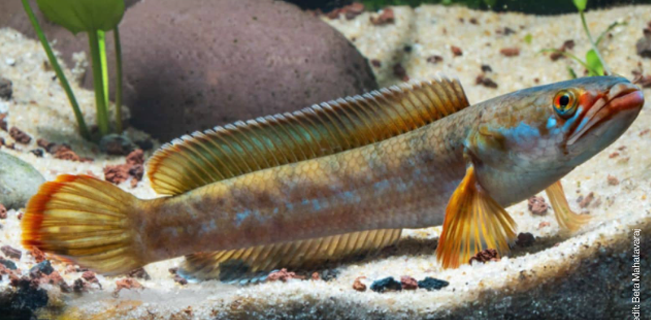
Hidden in a small stream flowing into the Simsang River in Meghalaya's South Garo Hills, scientists have discovered a striking new species of snakehead fish. Originally collected by aquarium hobbyist Farham Sangma, this small, vividly coloured fish has been named Channa nachi, after its local Garo name, and adds to the growing count of Northeast India's extraordinary freshwater biodiversity. Channa nachi belongs to the ‘gachua group’ of dwarf snakeheads, a species group known for its bright colours. What sets this new species apart is its unique appearance in completely lacking spots or blotches on the body. Beyond describing a new fish, the authors also clarify that Channa brahmacharyi is not a separate species, but is actually the same as Channa pomanensis, while confirming the validity of Channa melanostigma and Channa pomanensis as distinct species.
The discovery of Channa nachi raises India's total number of snakehead species to 25 and reinforces the Eastern Himalaya as a global hotspot for freshwater fish diversity. It also highlights the important role played by local collectors and hobbyists, whose observations are crucial to uncovering the region's hidden aquatic life.
Read the full story
Read the full story in the magazine: Readers who want the complete accounts — including the full authorship, methodology, and discussion behind each of these four discoveries — will find it in the December 2025 issue of The Weekend Aquarist.
👉Buy this issue or subscribe to The Weekend Aquarist to experience the full story.


Comments