
The Explorer's Eye: Meet Abhisek Mishra
Abhisek Mishra has no proper camera, no boat, and no formal training in ichthyology. What he has is an Android phone, a two-foot hand net, and a habit of wading into Odisha's rivers until something new swims by — a habit that has already put two fish species on the scientific record, and one of them, already, on the list of the threatened.
By Amar Salvi, Editor — The Weekend Aquarist
Estimated read time: 7–9 minutes
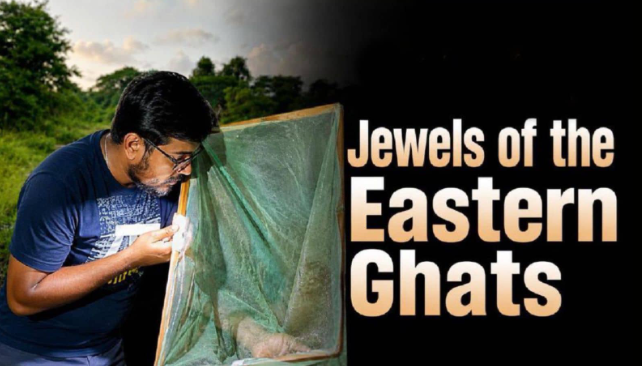
Abhisek Mishra's introduction to the hobby didn't begin with an aquarium. It began in front of his childhood home in Bhubaneswar, Odisha, and the anabas and clarias that lived in it — fish every local kid calls kohi maach, ordinary enough to ignore. Mishra didn't ignore them. “From childhood I was very fascinated toward all living creatures around me,” he says, “be it insects or reptiles or anything, but as I grew older I found my passion in fishes most likely.” A B.Tech graduate now preparing for government services exams, Mishra has spent his free hours for years doing something closer to fieldwork than fishkeeping: wading into the streams and tributaries that feed the Mahanadi river system, hand net in tow, phone camera ready. That phone is worth pausing on. Mishra's photographs — sharp enough to have been published in many publications, credited to scientific descriptions, and sought out by researchers and hobbyists across the country — are shot entirely on a Samsung mobile. No DSLR, no macro lens, no underwater housing. Just proximity, patience, and a two-foot-by-one-foot hand net sourced through friends in Chennai, because the best nets, he explains, come from Kolattur. It is, by any standard, a modest kit for the body of work it has produced.
From Hobbyist to Citizen Scientist
Mishra's turn toward serious documentation began around 2020, when he reached out to ichthyologist Balaji Vijayakrishnan — a name well known to Weekend Aquarist readers — hunting for an “old favourite,” the catfish Rita chrysea, which he'd learned was fairly common in his own backyard river. “He was kind enough to send me two or three live ones,” Balaji recalls. “It's a stunning catfish… that's how I got to know Abhishek, and it just kept getting more serious, in a good way. He started exploring habitats around his house, then a little further, and now he's straying further and further away, coming up with a lot of good findings.”

That drift outward from a childhood pond to a river system eventually produced something rarer than a good photograph: new species. Specimens Mishra collected and sent for study were formally described as Amblyceps crassioris — named for its comparatively thicker build than its congeners — and, in an entirely different genus, Pseudolaguvia permaris, whose name translates to “by the sea,” a nod to its coastal type locality. The permaris description, published in June 2023, was Mishra's first credit as the collector behind a new species. When asked whether the fish should carry his own name instead, he was unambiguous: “I will not prefer it, because I want it to be as scientific as possible. We are not doing favour to anyone — it's just scientific curiosity that should prevail.”
A River Disappearing in Real Time
The discoveries carry a harder edge. The original habitat where Mishra first found Amblyceps crassioris — a clear-watered, muddy-bottomed stream — no longer exists in a state the fish can survive. Untreated sewage now flows into it. “The species has been extirpated from this particular habitat,” Mishra says of a photograph taken just three years earlier. The type locality for Pseudolaguvia permaris has fared little better: sand mining and a temporary dam built to divert water to the city turned a flowing stream into a stagnant, polluted pool. Both observations have been forwarded to the IUCN, which will now record both species as under threat — species named to science and flagged as endangered within the same handful of years.
A River's Cast of Characters
Much of Mishra's footage and photography maps the Mahanadi's smaller residents. In the shallow, weed-choked stretches he photographs school after school of dwarf barbs — the dotted Pethia ticto, close enough to the rosy barb, Pethia conchonius, that the two are best told apart by the small spots on ticto's dorsal fin; the golden dwarf barb, Pethia gelius, part of a three-species complex; Pethia canius and the diminutive, translucent Pethia guganio, a northern cousin of the Mumbai-endemic P. fraseri and the Chennai-endemic “sharma” barb; and the green-spotted Pethia phutunio. A close relative, Oreichthys cosuatis, stood out for a different reason: a sexually dimorphic species whose males grow a taller, more colorful dorsal fin to outdisplay rivals, it wasn't previously associated with Odisha at all — even ichthyologist Beta Mahatavaraj hadn't realized it occurred until Mishra's photographs turned up. Upstream, at a waterfall called Gudguda, Mishra has photographed pools where Tor mahanadicus — the Mahanadi mahseer, only recently revalidated as its own species after decades of being lumped in with Tor tor — congregate in numbers large enough to draw local tourists who feed them by hand.

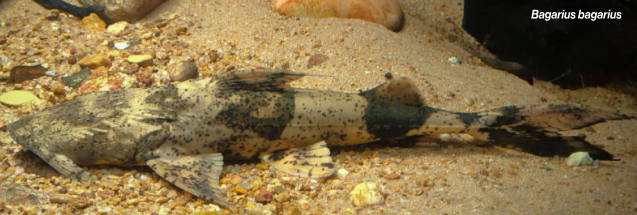
The catfish tell a rougher story. Mishra's photographs of Rita chrysea, with their tall, spine-like dorsal fins, capture a species so feisty in the net that handlers routinely draw blood, and so strong it punctures triple-bagged transport packets. He has also documented Sperata lamarii, a red-tailed catfish previously overlooked in Odisha because of its resemblance to the far more common Sperata aor — recorded here for the first time thanks to specimens he sent for confirmation. And then there is Bagarius bagarius, the goonch, whose reputation as a man-eater Mishra and Balaji dismiss outright as folklore built on the species' habit of scavenging near cremation grounds; the Mahanadi and Bengal populations, they note, run noticeably more speckled than the banded goonch of the Ganges.
The river's larger, harder-to-source catfish get their own chapter in Mishra's catalogue. Silonia silondia, a top-water predator, took six months in his tank before it would take food from his hand — a fish prized enough abroad that hobbyists in Thailand and Malaysia will pay handsomely to keep one alive. Clupisoma bastari, a long-barbelled schilbeid, turned up as a gravid female during the first monsoon rains; and Ailia coila, another long-whiskered species, is eaten far more often than it is kept, since its spines and barbels rarely survive the trip from river to aquarium undamaged.

Further up, in faster, oxygen-rich water, Mishra's lens finds the fish nobody keeps for long: fast-swimming danionins that gasp and perish within minutes of leaving the river, Tariqilabeo latius, a rheophilic species built to graze algae off rocks in strong current, and Paracanthocobitis mackenzie, a bottom-dwelling loach that prefers the same fast water. Among the rarer finds are Chagunius chagunio, a vividly orange-finned cyprinid from the Similipal Tiger Reserve region of Odisha's Eastern Ghats, and Channa harcourtbutleri — a brightly marked snakehead long associated with Myanmar, only recently confirmed by molecular work to also occur, oddly and without explanation, along India's Eastern Ghats and Western Ghats, skipping the country's interior entirely.

Still Exploring
None of this required a grant, an institution, or an expedition budget — just a hand net, a phone, and a willingness to keep going back to the water. Balaji, for one, doesn't see that as a limitation: keep exploring, keep sharing, is the plainest way to put what Mishra's work has already proven — that some of the most consequential fieldwork in Indian ichthyology right now is being done by hobbyists with ordinary gear and an explorer's eye.
Watch & read the full story
Read the full story in the magazine: Readers who want the complete conversation, along with the full photo record of Mishra's fieldwork, will find it in the July 2026 issue of The Weekend Aquarist.
👉Buy this issue or subscribe to The Weekend Aquarist to experience the complete tribute.


Comments