
The Secret Life of Gobies
A journey into the fascinating world of gobies, from their surprising personalities and remarkable behaviours to the hidden species, habitats, and field discoveries that make these small fish so extraordinary.
By Aravind Manoj
Estimated read time: 3–4 minutes
I have been documenting fish for almost six years. What began as simple curiosity slowly became a serious passion. I have always been a native fish lover, but when it comes to gobies, they hold a very special place in my heart. There is something about them that feels different from other fish. They may be small in size, but their behaviour, intelligence, adaptability, and character make them truly fascinating.
Small Fish, Big Personalities
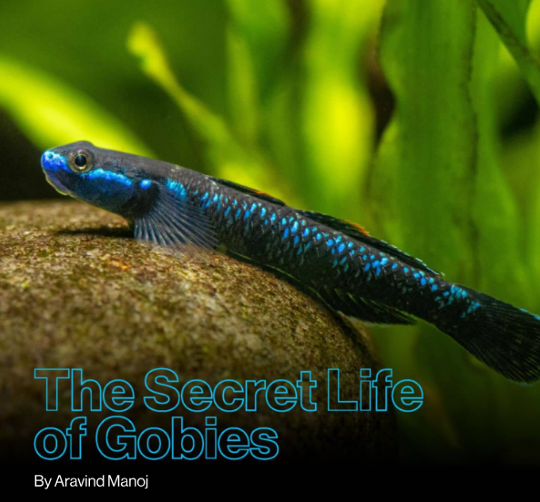
Gobies behave in ways that constantly surprise. They are highly territorial — when two males encounter each other, they flare their fins, intensify their colours, and display dominance with confidence far bigger than their size. Watching one sit calmly on its favourite rock, observing everything around it, even looking back at you, feels incredibly peaceful. They are not just fish swimming randomly; they have personality. Each one chooses its own resting spot, its own territory, and defends it seriously. The fascination deepened further with marine species. Learning about the prawn goby and its symbiotic relationship with pistol shrimp was a turning point — the goby stands guard while the nearly blind shrimp digs and maintains the burrow they share. Both depend on each other for survival. That level of cooperation in nature is hard to look away from once you know it exists. Around the same time came the mandarin goby, whose colours look almost unreal — proof of just how diverse and beautiful this group of fish can be.
A Small Fish's Devotion
Gobies also have genuinely beautiful mating rituals. During breeding time, the male becomes extremely vibrant — he spreads his dorsal fins wide and performs a gentle but confident dance around the female, his colours glowing more intensely as his territorial behaviour increases. Eggs are laid beneath rocks, driftwood, or inside cave-like structures. After spawning, the male takes full responsibility — he guards the eggs, cleans them constantly, and fans them with his fins to prevent fungal infections. Watching this parental care changes how you see such a small fish. It shows dedication and instinct at its finest.

A Goby Missing Since 1876
Through years of continuous observation in India's mangroves and estuaries, one moment stands apart from all the rest. During fieldwork, a small, unremarkable-looking goby kept turning up — one that didn't match anything in the current records. For a long time, it was simply referred to as a “mystery goby.” The species had originally been recorded by Francis Day in 1876. Since that early record, there had been no clear documentation or confirmed observations of it in the wild — over a century of silence. Its identity was eventually confirmed by Helen Larson, one of the world's leading goby experts and author of Gobioids of the World.

It showed me that even a species recorded more than a century ago can remain unnoticed, and that careful fieldwork and dedication can help bring such forgotten species back into scientific attention.
What Low Tide Reveals
Much of this fieldwork happens in mangrove ecosystems, and always by choice at low tide. When the water recedes, gobies that high tide hides remain under rocks, inside burrows, or stuck in shallow pools. The entire estuary becomes a living stage — fiddler crabs raising their oversized claws to fight for territory, mudskippers chasing each other across the exposed mud, whimbrels probing the sediment for worms. Not every trip ends in discovery, though. A journey to Karnataka in search of the redneck goby, in its natural habitat, found nothing — the site altered by urbanization and dam construction. A reminder of how quietly habitat destruction can erase a species before anyone fully understands it.

A Mentor, and a Trip That Found Nothing
A teacher, Beta Mahatvaraj — also known as Meenkaran — played an important role in strengthening this interest in gobies. He'd worked closely with the redneck goby, Schismatogobius deraniyagalai, a species that opens its red mouth wide during fights, creating an intense visual display. Seeing that behaviour up close only deepened the fascination. In 2024, the two travelled to Karnataka hoping to document that same species in its natural habitat. They found nothing — the site altered by urbanization and dam construction, not a single specimen turning up. That trip was emotionally heavy. It was a reminder of how fragile freshwater ecosystems really are, and how quietly habitat destruction can erase a species before anyone even fully understands it. Gobies, along with loaches, also turn out to matter for reasons that have nothing to do with how they look. Both groups are important bioturbators — constantly disturbing and turning over sediment while feeding, a process that oxygenates the substrate, prevents anaerobic zones, and supports microbial life. In simple terms, they're ground-level cleanup crews. Their presence indicates ecological health, and removing them can disturb nutrient cycles and sediment balance far beyond what their size would suggest.
The Ones Almost No One Keeps
Interest later expanded toward amphidromous gobies — species like Stiphodon and Sicyopus, including favourites like the Red Lipstick Goby and the Blue Neon Goby. Amphidromous gobies have a genuinely unusual life cycle: they spawn in freshwater streams, their larvae drift downstream into the sea to develop, and after growth, the juveniles migrate all the way back upstream into fast-flowing hill streams. That life cycle makes captive breeding almost impossible — which is why aquarium shops mostly sell only males, and why many hobbyists buy them without understanding what they actually need to survive.

Stiphodon species are specialised algae grazers, with brush-like teeth built to scrape biofilm off rocks; they demand strong flow, high oxygen, and mature algae-covered stones. Sicyopus species prefer fast streams too, but feed more on live or frozen food — without the right flow, oxygenation, and diet, these fish simply don't survive long in captivity. Because of these challenges, rare imports have been arranged over the years — species very few hobbyists in India keep at all, each one teaching something new about adaptation and behaviour.
The Fish With No Photograph
The ultimate dream now is to find and document even rarer Indian gobies. One species in particular stands out — described in 1971 from the Indian Ocean, with no live photographs available anywhere. The idea that a fish exists without a single living visual record is not something easily let go of.

People often travel across continents to see large animals. This is a journey through mangroves, estuaries, and rocky streams instead, to observe small gobies — because in their tiny bodies lies evolution, adaptation, survival, and resilience. Gobies may be small, but they carry big stories. And that search continues, one tide at a time.
Read the full story
The complete feature — including the full mentorship story, the courtship rituals of gobies, India's hidden goby diversity, and Aravind's rare imports and ongoing search for India's least-documented species — appears in the February 2026 issue of The Weekend Aquarist.
👉Buy this issue or subscribe to The Weekend Aquarist to experience the full story.


Comments